

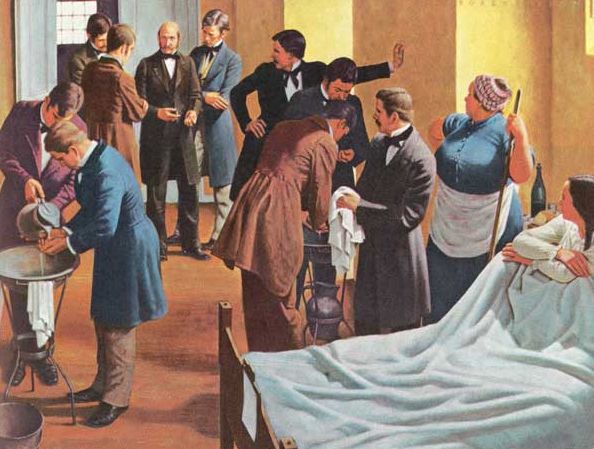
 In 1847, a German doctor, seeking to reduce the mortality rate among pregnant mothers, noted that medical students would perform autopsies in the morning, then go directly from the morgue to the hospital wards without washing their hands.
He ordered everyone in his ward to wash his or her hands thoroughly in a chlorine solution after every examination. In three months, the death rate fell from 18% to 1%.
Had Dr Semmeliweis simply read the Pentateuch, he could have learned what the ancient Israelites knew three thousand years before;
“He who touches the dead body of anyone shall be unclean seven days. He shall purify himself with the water on the third day and on the seventh day; then he will be clean. But if he does not purify himself on the third day and on the seventh day, he will not be clean.” (Numbers 19:13)
Moses also gave instructions for the mixing of the ‘water of separation’ [or ‘purification’.] Numbers 19:17’s ingredient list sounds like a typical superstition.
It calls for the combination of the ashes of a red heifer, hyssop, cedar wood and scarlet.
In point of fact, this combination of ingredients produces what amounts to an antibacterial soap. Lye soap is made by pouring water through ashes.
Hyssop’s medicinal properties include expectorant, carminative, relaxes peripheral blood vessels, promotes sweating, anti-inflammatory, anti-catarrhal, antispasmodic.
Its active constituents are volatile oil, flavonoids, tannins and bitter substance (marrubin).
A strong tea made from the hyssop leaves and flowering tops is used in lung, nose and throat congestion, and externally it can be applied to bruises, to reduce the swelling and discoloration.
Cedar has long been favored for use in storage cabinets because of its ability to repel insects and slow decay. In oil form, applied to humans, it is an antiseptic, astringent, expectorant (removes mucus from respiratory system), anti-fungal, sedative and insecticide” (“Spa Essential Oils,” 2005).
Cedar leaves and twigs are rich in vitamin C, and it was their effectiveness in preventing or treating scurvy that led to the tree’s being called ‘arbor vitae’ or’ tree of life’.
Lastly, Moses called for the inclusion of ‘scarlet’ — mostly probably scarlet wool. (Hebrews 9:19) Adding wool fibers to the ‘water of purification’ would make it gritty, like Lava soap.
The education Moses received in Egypt taught him to treat open sores with animal dung, but Moses taught the Israelites how to make lye soap.
The book of Leviticus lists a number of diseases and outlines ways by which an Israelite would come in contact with germs. Those with such diseases as leprosy were instructed to “dwell alone” “outside the camp” (Leviticus 13:46).
If and when a diseased individual did get close to those who were not diseased, he was instructed to “cover his mustache, and cry, ‘Unclean! Unclean!” (13:45).
Here’s another seeming superstition; the ‘covering of one’s mustache’ to prevent disease. Until you give it about three seconds thought — what do you do when you cough — and why?
We are taught to ‘cover our mustaches’ to keep from spreading germs!
So, Moses, having been educated in the finest schools in Egypt in the many uses of poop in the treatment of disease, prescribed the use of soap and water to prevent disease and instituted the practice of quarantine to prevent its spread — three thousand years ago in the middle of the Sinai desert!
The ancient Israelites were instructed in peculiar dietary habits such as avoiding certain animals, birds and fish as sources of food. (Leviticus 11:1-3)

